Kenyatta Avenue viaduct: what is being built, why it stalled, and when it will open
A KSh3 billion elevated road is rising between Nairobi's CBD and Upper Hill. President Ruto says it has passed 50% and should open in May 2027. Here is what it is, why it took six years, and what changes for motorists.
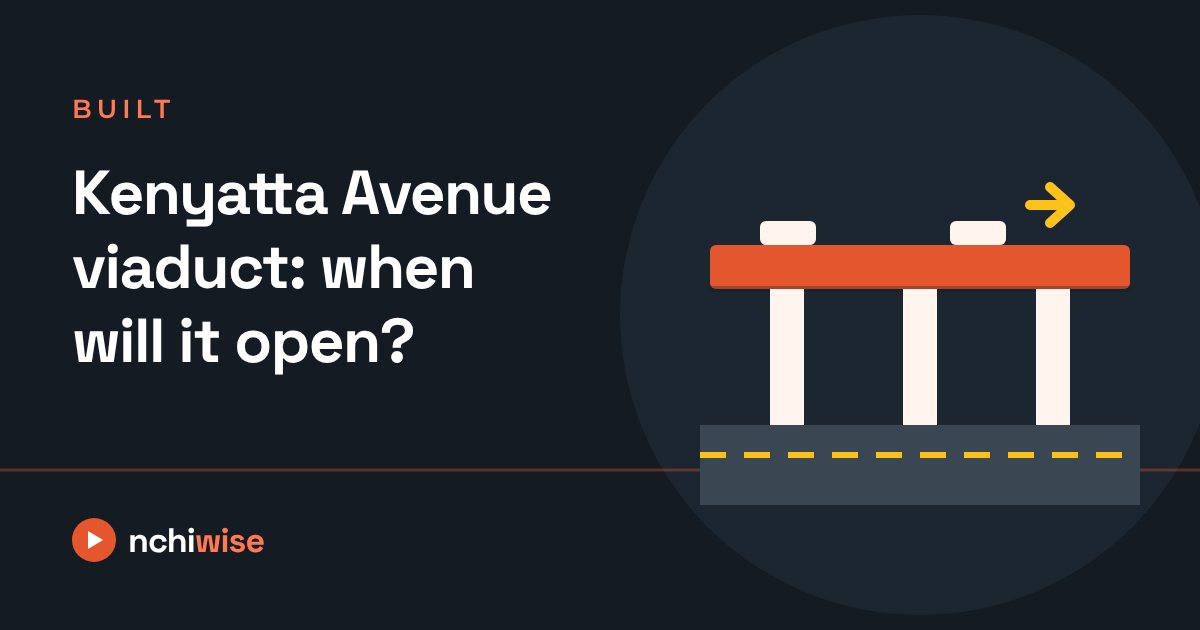
If you drive between Nairobi's CBD and Upper Hill, you have seen the giant concrete columns near All Saints Cathedral. They are the Kenyatta Avenue viaduct, an elevated road meant to take traffic over one of the city's worst junctions. On 1 November 2026, President William Ruto said the project has passed the halfway mark.
The project at a glance
| Item | Detail |
|---|---|
| What | An elevated dual carriageway, about 1km long, with bicycle lanes and footpaths |
| Where | Along Kenyatta Avenue, roughly from Integrity Centre to the Serena Hotel, linking the CBD and Upper Hill |
| Cost | About KSh3 billion |
| Built by | China Road and Bridge Corporation, for the Kenya Urban Roads Authority (KURA) |
| Progress | "More than 50%" (President Ruto, 1 November 2026) |
| Expected completion | 30 May 2027 (Kenya Roads Board) |
Part of a bigger plan
The viaduct is one of three linked projects meant to untangle traffic around the CBD's western edge:
- the Kenyatta Avenue–Upper Hill viaduct itself;
- the Valley Road–Kenyatta Avenue/Ngong Road/Nyerere Road interchange; and
- the Upper Hill–Haile Selassie overpass.
Together they aim to give drivers a direct, non-stop route between the CBD and Upper Hill, and to ease pressure on Valley Road, Kenyatta Avenue and Haile Selassie Avenue at rush hour.
Why it has taken six years
- 2020: construction began in September.
- Stalled: work stopped for several years over payment disputes with the contractor.
- July 2025: work resumed after the government secured financing.
- 2026: the target moved from December 2026 to May 2027. KURA said installing the large columns and steel parts is complex "precision engineering" that has to be done in phases.
What it means for you
- Until mid-2027: expect lane closures and slow traffic around All Saints Cathedral, Kenyatta Avenue and Valley Road. Leave extra time, especially at rush hour.
- After it opens: trips between the CBD and Upper Hill should be faster, with fewer stops at junctions, plus safer space for walking and cycling.
- Watch for: whether the May 2027 date holds, and progress on the linked interchange and overpass, which the full benefit depends on.
Related: Nairobi's CBD makeover and the planned Thika expressway.
Watch the video

Sources
- Kenyatta Avenue viaduct crosses 50% completion mark, Ruto announces, Kenyans.co.ke (1 Nov 2026)
- Kenyatta Avenue viaduct set for May 2027 completion, KRB says, Kenyans.co.ke (22 Sep 2026)
- Upper Hill–Kenyatta Avenue viaduct 60% complete, The Star (8 Jul 2026)
- KURA attributes Kenyatta Avenue viaduct delay to complex engineering works, Kenyans.co.ke (6 Jul 2026)